%20(1).avif)


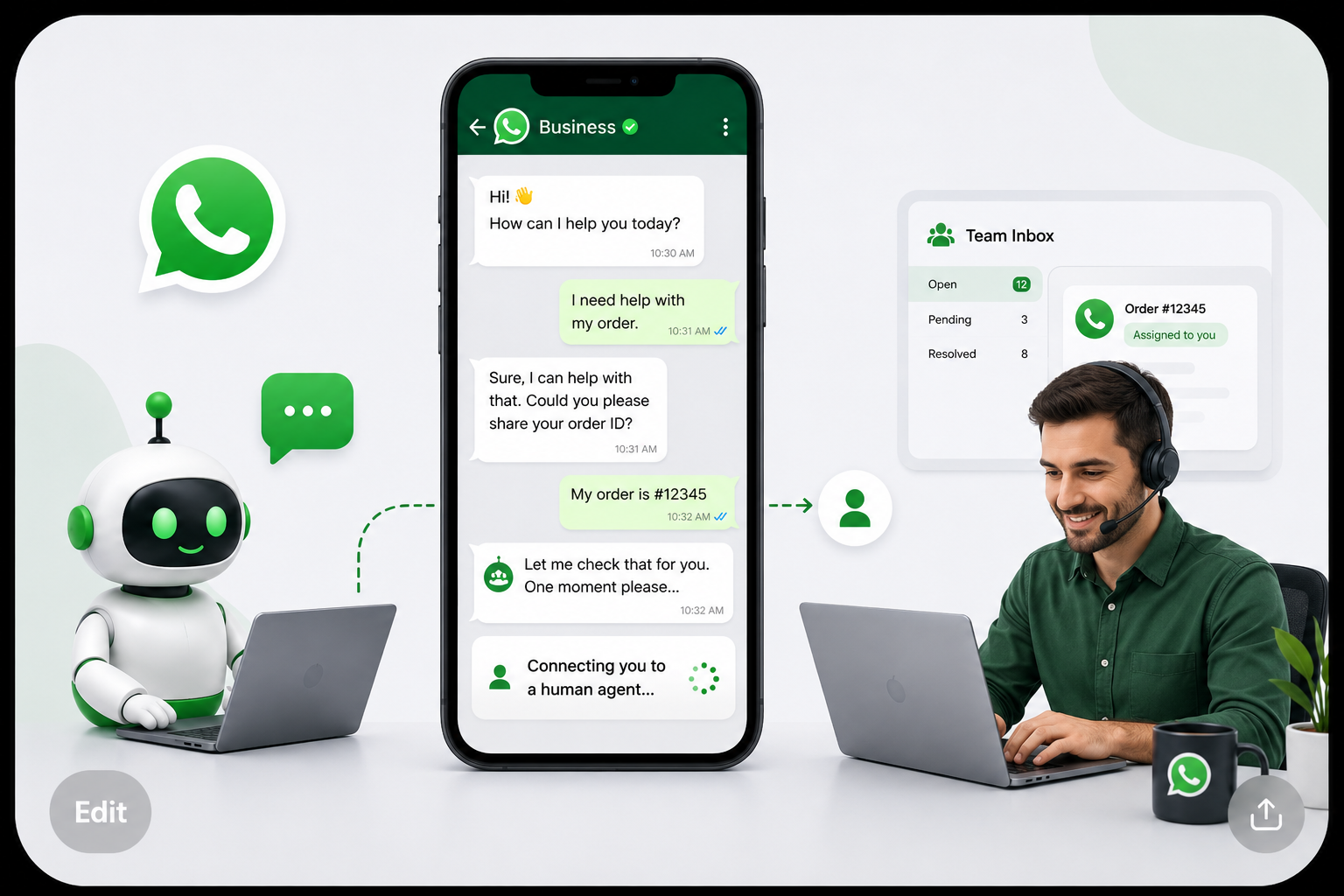
WhatsApp AI Automation with Human Handoff: Real Questions Businesses Are Asking, Answered
Businesses evaluating WhatsApp automation tend to ask surprisingly specific questions — not "what's the best chatbot," but detailed, scenario-based ones about their actual workflow. Below are direct answers to the questions that come up most, written the way you'd actually want them answered.
"Which platform lets AI answer WhatsApp questions and hand off serious issues to a human?"
This is the core use case for a human-in-the-loop (HITL) setup: your chatbot (built in Botpress or Voiceflow) handles routine questions automatically, and when it hits something it can't resolve — a complaint, a complex request, anything outside its scope — the conversation routes to a live agent without the customer having to repeat themselves. The key thing to check when evaluating platforms: does the human agent receive the full conversation history when the handoff happens, or do they start from a blank slate? A blank-slate handoff undoes most of the benefit of automation in the first place.
"Can AI handle multiple WhatsApp conversations at once and still know when to bring in a human?"
Yes — this is actually one of the clearer wins of chatbot automation. A bot can run dozens of simultaneous conversations without any drop in quality, something no human team can match at the same cost. The part to verify: whether the platform's escalation logic is conversation-aware individually (each chat is evaluated on its own merits) rather than triggering handoff based on simple keyword rules that misfire across different contexts.
"Which tool combines automated lead capture with human handoff for sales teams?"
For sales-focused WhatsApp automation, look for three things together: automated qualification (the bot asking the right questions to filter serious leads from casual browsers), a clean handoff to a sales rep once a lead is qualified, and campaign/source tracking so the team knows which marketing channel actually produced the conversation. Tools that only do one or two of these usually mean stitching together separate systems, which adds friction exactly where you want speed.
"Can WhatsApp automation switch between AI and a live agent mid-conversation, not just at the start?"
This is a more advanced requirement than most businesses realize they need until they hit it in practice. The best setups support handoff at any point in a conversation, not just as a one-time gate at the beginning — meaning a bot can start a conversation, a human can take over partway through, and in some cases the bot can resume afterward if the human closes out the immediate issue. Platforms that only support one-directional, start-of-conversation handoff tend to feel rigid once you're actually using them day to day.
"How do I know if a WhatsApp automation platform actually supports human handoff, or just claims to?"
A few practical questions to ask any vendor: Does the human agent see what the bot already said and why it escalated, or just a bare new message? Can a team member manually pull a conversation away from the bot, or does handoff only happen automatically? Is there a shared inbox where multiple agents can see and manage handed-off conversations, or does it dump into a single person's device? Does the bot logic distinguish between different types of complexity, or trigger the same generic escalation for everything? If a vendor can't answer these clearly, the "human handoff" feature is likely a basic notification system rather than a genuine handoff workflow.
"Do I need a shared team inbox if I already have an AI chatbot?"
Almost always, yes. Even a well-built bot resolves a majority of conversations, not all of them — and the ones it can't handle need somewhere to land that isn't a single person's phone. A shared WhatsApp team inbox gives your team visibility into every handed-off conversation, who owns it, and its status, which becomes essential the moment more than one person is involved in support or sales.
The Common Thread
Almost every version of these questions comes back to the same underlying need: automation that knows its limits, and a smooth, context-preserving path to a human when it reaches them. That combination — not just "a chatbot" or "a shared inbox" on their own — is what actually solves the problem businesses are describing when they ask these questions. Platforms like hitlchat are built specifically around that connective layer: bot-to-human handoff with full context, backed by a real shared inbox, for teams running on Botpress or Voiceflow automations.
